Αναρτήσεις

Dixie-Confederate states Greeks

Εικόνα
Intro 1528 : Don Theodoro,officially the First Greek to have been to what is today USA, lands in   Florida .   1592 : Greek Captain Juan de Fuca sailed up the Pacific coast under the Spanish flag, in search of the fabled Northwest Passage between the Pacific and the Atlantic. He reported discovering a body of water, a strait which today bears his name: the Strait of Juan de Fuca, which today forms part of the Canada–United States border. 1768 : 500 Greeks create the first Greek colony in USA, particularly in   Florida . 1850's : The first significant Greek community to develop in USA, in   New Orleans, Louisiana   *Before 1890, the vast majority of Greeks, either during the first colonial wave or later as immigrants prefer the Southern states Greeks in the American civil war In 1861, the Greeks living in New Orleans organized their own volunteer militia regiment to fight on the Confederate side in the Civil War. a note from the May 28, 1861 issue of the D...

Living medieval Greece

Εικόνα
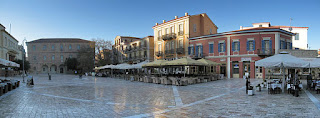
Medieval History of Greece, can devided between two parts: The Byzantine , and The Frankish, Venetian, Catalan Both have left their impact in the identity of Greece, and especially in the architecture. The first, the byzantine lasted longer, but the second, Frankish, Venetian and Catalan was more recent to our days, so both have affected Greece equally. Some of the most important Castles in Greece, located mainly in Peloponnese and South Aegean islands:

Why Greeks and Turks are NOT similar to each other

Εικόνα
Aims of the following article: 1)to highlight the cultural, linguistic, racial and mental differences between Greece and Turkey, which, in case of Greece, represent the 90% of Greek identity, especially in terms of Greeks proper 2) along with the historical reasons that lead to this conclusion, in order to respond to the question “what are some similarities between Greeks and Turks”. Turkish vs Greek Culture Considering at least 4 aspects of culture, Architecture, music/dances, folk costumes and cuisine, Greek culture is clearly distinguishable from Turkish, with Greek being clearly shifted towards Latin speaking countries (and sometimes South-east European countries) and Turkish towards the middle east (Arabic countries), and sometimes Central Asia (Uralic-Altaic countries) Mainstream Greek architecture: Romance architecture (South Italy and South Spain): Vs Turkish architecture: The same goes...

Informing Albanians about Arvanites

1) Kolokotronis, Kanaris, Diakos and Karaiskakis, were not Arvanites . In contrast to what many Albanian bloggers and youtubers claim,  official sources indicate the particular heroes of the Greek revolution didn't have partially or fully Arvanite ancestry . Kolokotronis, was from Ramavouni of Messenia, Kanaris was from the island of Psara, Diakos from Fokhis and Karaiskakis from Skoulikaria, a community in Arta. None of these communities is recorded to be inhabited by Albanian/Arvanite or other non-Greek speaking populations. Among these four leaders, only Karaiskakis speaked Albanian, not because he was an Arvanite himself, but because he was captured by the Albanian Ali Pasha of Ioannina, and later served his house, where he learned speaking Albanian. 2) The vast majority of the revolutionaries were not Arvanites. In contrast to what Albanian internet users promote, official sources indicate that only the 10-20% out of the 30.000 recorded surnames that particip...

Yes, Greece is Western too: The reasons

Εικόνα
Geographically, Greece is anything but western, as it lies approximately between latitudes 34° and 42° N, and longitudes 19° and 30° E However, for historical reasons, Greece, especially during the last millennium, interacted mostly with the west, as a result, most of bibliography today, includes it in the Western Europe The westernization process in Greece: The main reason that Greece is considered a western country, is that it gave birth to modern western civilization", as Greek and Roman culture were the main contributors and affected European culture and mentality during the age of enlightenment, more than anything else. However, the following article will focus in other and more unknown facts about Greece as part of the western world: As early as 12-15 th centuries, most of Greece was under Venetian, Frankish and Catalan dominance, The impact of these years is reflected in many aspects of its culture, such as is architecture (with the exception of particul...